A route map for grants, capital, communities, regulation and global expansion for Australian digital-economy founders.
Editorial guide by Redditech Labs. Not a lab product or service. Last verified 22 July 2026; being re-checked.
Reader Note
This article is general information and ecosystem analysis. It is not legal, financial, tax, migration, investment or grant advice, and it should not be relied on as a substitute for qualified professional advice. Founders should speak with appropriate lawyers, migration advisers, accountants, grant advisers, financial advisers or sector specialists before acting on incorporation, visas, IP, licensing, tax, grants, fundraising, payments, digital assets or AI obligations.
It reflects the best knowledge gathered up to 22 July 2026 AEST. Treat it as the starting point for a living document: programs, regulator settings, community resources and government initiatives will change as policies are introduced, paused, amended or repealed over time.
Abstract
Australia has research talent, skilled migration, international students, state programs, the R&D Tax Incentive, the Industry Growth Program, credible regulators, private capital, superannuation scale and active founder communities. The problem is routing. Founders still have to stitch together program pages, regulator guidance, state rounds, community networks, grant rules, capital expectations and offshore expansion choices by themselves. This article proposes a Founder Journey Planner: a maintained routing layer that shows the next step to check, the warning label to read, and the trusted community or adviser who can interpret it. Good routing does not promise unicorns by itself. It helps more founders incorporate cleanly, reach customer proof faster, avoid avoidable compliance and funding mistakes, and stay anchored in Australia longer before expanding offshore. That is the practical bet behind the Founder Journey Planner.
The Route Is The Product
Many founders experience Australia's startup system as either a grants maze, a regulator maze or an insider network. The support is broader than that, but it is poorly sequenced. The missing piece is the order of operations: what to check first, what evidence to gather, which official page matters, which adviser or community can interpret it, and which milestone makes the next step worth taking.
Founders rarely start with a policy category. They start with a constraint. One person has a half-built product and a visa question. Another has a university invention and unclear IP rights. Another has a payments workflow that might be regulated before the first customer signs. Another has customer interest but no credible path from pilot evidence to capital. Australia needs a map that starts from the founder's actual constraint.
A skilled migrant who has earned work rights is not asking the same first question as a PhD researcher, international student, payments operator, regional builder or returning diaspora founder. They may all be building in the same digital economy. They do not need the same starting point.
The practical answer is route tailoring: show support by founder pathway and stage, build capital bridges, publish dated regulatory maps, treat communities as interpreters, and make offshore expansion a staged decision rather than a status move.
Take the skilled migrant founder as the simplest example. They may already have domain expertise, Australian work rights, a local network and a product idea, but their first risks are not always product risks. They may need to understand permanent-residency timing, employment restraints, tax setup, IP separation from a current employer, product classification, and which adviser can safely answer which question.
Only after that route is visible does the familiar startup language become useful. A grant might matter later, but not before the founder knows whether the company can be formed cleanly. Capital might matter later, but not before the product has customer proof and a story investors can diligence. Offshore expansion might matter later, but not before it solves a real bottleneck. That is why the tables below start with founder pathway rather than program name.
Start Here: Find Your Route
Read this as a route map, not a policy essay. The first table gives the short answer. The second gets different readers to the most relevant section quickly. The third keeps the innovation, investment and competitiveness argument in one place before the longer evidence sections.
| Question the article is answering | Short answer |
|---|---|
| What support exists? | R&DTI, IGP, state pathways, startup communities, accelerators, hubs, sector bodies, regulator materials, private capital and a large superannuation pool all exist, but they are scattered and unevenly legible. |
| Where is the gap? | The gap is not only funding. It is routing: founders do not know which support fits their pathway, stage, product, state, visa/IP constraints, regulatory exposure or community context. |
| Why do competitors pull founders away? | Singapore, Dubai/UAE, Vietnam and Silicon Valley package the founder journey more clearly: setup, credibility, talent, capital, licensing or customer access. Australia often has comparable ingredients but weaker front doors. |
| What should Australia build? | A Founder Journey Planner that turns official programs, communities, regulatory maps, capital bridges, pilots and offshore-expansion choices into a clear next-step system. |
| Why do communities such as Superteam AU matter? | Builder communities can translate fast-moving opportunities into action: grants, protocol work, stablecoin/payment experiments, compliance-aware collaborators and credible demo loops. |
| If this is the founder | Start with this section | First practical move | Skip if you only need... |
|---|---|---|---|
| Student or recent graduate building AI/software infrastructure | The international student journey | Check work rights, university IP and experiment records before chasing grants. | the full capital or competitor comparison |
| Payments, stablecoin or digital-asset operator | The migrant operator journey and regulatory clarity | Classify the product across ASIC, Treasury, AUSTRAC and RBA tracks before fundraising on the story. | broad startup-program summaries |
| Research or deep-tech founder | The research founder journey and support pathways | Confirm IP rights, technical uncertainty evidence and customer proof before applying for commercialisation support. | digital-asset regulatory detail |
| Regional, returning diaspora or community-led founder | The Planner map and community section | Find the nearest trusted interpreter: local hub, state front door, sector community or national builder network. | only the source appendix |
| If you want to understand | Go to |
|---|---|
| Why the paper argues for routing, not another program list | How This Analysis Was Built and A Founder Operating System, Not A Portal |
| What support exists today | What Founders Can Use Now |
| Why capital feels thin despite Australia's savings base | Capital: Australia Has A Pool, Not A Pipe |
| How digital assets, payments, AML/CTF, tokenisation and AI fit together | Regulatory Clarity Is Competitiveness |
| Why communities and Superteam AU matter | Communities Translate The Route |
| Why founders compare Singapore, Dubai/UAE, Vietnam and Silicon Valley | Competitor Pressure: Founders Compare Routes |
| What Australia should do next | What Australia Should Do Next |
| Article lens | Current Australian strength | Current founder friction | Practical fix |
|---|---|---|---|
| Innovation | Public R&D support, research talent, AI/cyber/deep-tech capability, state programs and sector customers. | The first route differs by founder type: student, migrant operator, researcher, regional founder or spinout. | Route by founder pathway and product shape before routing by grant name. |
| Investment | Private capital exists, ESVCLP settings exist, and superannuation gives Australia a large long-duration savings base. | Early founders still need investable milestones, customer proof and fundable evidence before institutional capital can matter. | Build bridges through VC/growth vehicles, co-investment, procurement proof and cleaner startup performance data. |
| Competitiveness | Australia has trust, regulators, sector customers, founder communities and a credible base for regulated digital infrastructure. | Other ecosystems often feel easier because the founder door is clearer: licensing, setup, capital, talent or market access. | Publish dated route maps and offshore-expansion decision guides instead of leaving founders to infer the path. |
How This Analysis Was Built
This article is based on public-source research checked across official program pages, regulator materials, industry-body publications, ecosystem sources and international comparison points current to 22 July 2026. Core visa, virtual-asset and dated regulatory claims were re-verified against live sources on 22 July 2026; wider program and round statuses remain point-in-time and should be rechecked before acting on them. It is not a survey of every founder experience and it does not claim to replace legal, migration, tax, grant, financial or other professional advice.
The inference is drawn from repeated fragmentation across the source set. R&DTI depends on activity-level evidence rather than startup identity. IGP is advisory-first and priority-aligned rather than a general startup grant. State support is round-based and uneven across jurisdictions. Digital-asset, payments, AML/CTF, tokenisation and AI rules sit on separate tracks. Communities often hold the practical interpretation layer that official pages cannot maintain alone. That pattern supports the article's central claim: the binding design problem is not only whether support exists, but whether founders can find the right sequence.
The founder journeys below are archetypes, not invented case studies. They are highlighted because each tests a different failure mode in the Australian route map: immigration/IP, regulation/capital, and commercialisation/customer proof. They are not demographic claims about founder quality, not a ranking of founder types, and not an exhaustive list. Regional, returning diaspora and underrepresented founders appear in the map because their common first-order problem is route visibility and trust rather than one uniform grant or regulator pathway.
Three Founder Journeys
A Founder Journey Planner becomes useful when it changes the next action. The three journeys below show the Planner doing its job: changing the founder's next move.
The international student building an AI infrastructure company
The founder is finishing an Australian degree and has found a real technical problem in model evaluation, data provenance, agent safety, workflow automation or compute orchestration. The Planner should not send them straight to a grant list. It should sequence the first month clearly, then keep three parallel checks visible as the company forms.
The first month is legal and institutional hygiene. Does the university claim IP? Can the student work on the company under the relevant visa/work settings? Are there employment, scholarship or lab-access constraints? Those questions determine whether the founder can safely incorporate, assign IP and raise capital.
Work rights before grants
The visa layer deserves precision, because hidden rules bite first. A student visa holder can legally own a company, but Home Affairs publishes no founder-specific guidance on whether active hours spent building a startup count as "work" against the 48-hour fortnightly cap — the conservative practitioner reading is that they do, even unpaid.
The Temporary Graduate visa (subclass 485) is the real founder window: usually two to three years of unrestricted work rights depending on qualification, though settings have tightened, including a 35-year age cap for most applicants and visa costs that now need to be checked in the official Visa Pricing Estimator at lodgement rather than copied from an old fee table. At the exceptional end, the National Innovation Visa (subclass 858), which replaced the Global Talent visa in December 2024, offers invitation-based permanent residency for founders with internationally recognised achievement.
A Planner that cannot answer "can I legally work on my startup this semester?" is not routing the founder who needs it most.
Evidence, peers and policy
The first parallel check is experimentation evidence. If the company is genuinely solving hard technical uncertainty, the R&D Tax Incentive may become relevant later. The founder should document experiments from the beginning: hypotheses, known methods rejected, test conditions, observations, failure modes and conclusions. They should not assume "AI startup" equals R&DTI eligibility. Routine implementation, known API integration and normal software assembly are weak fits; experimental technical uncertainty is the centre of the claim.
The second parallel check is community. Build Club, university founder programs, Arrayah-style hackerhome or residency environments, Startmate, Antler Australia and specialist AI communities can help the founder find peers, co-founders, feedback loops and first customers faster than static government pages. Arrayah fits this map as emerging hackerhome/residency/community infrastructure rather than a grant, accelerator or public institution.
The third parallel check is policy and market trust. The 15 July 2026 AI announcement means the founder should track the Office of AI, Australian Standards for AI, creator-control/copyright commitments, safety expectations and data-centre obligations if the product depends materially on large-scale AI infrastructure. An application-layer company may not be directly governed by data-centre rules, but it still needs a credible answer on training data, model behaviour, safety, procurement and customer trust.
At this stage, the announced AI standards and obligations appear most directly aimed at large data centres, AI training infrastructure and government-facing standards work. Application-layer duties should be treated as a watch item until draft legislation, standards or procurement rules make the boundary clearer.
For this founder, the Planner's sequence is: work rights and IP first; peers, customers and experiment records in parallel; R&DTI only where the activity fits; IGP only if intake reopens and the project is priority-aligned and commercialisation-ready; offshore expansion only when the bottleneck is customers, capital or talent density rather than status anxiety.
The migrant operator building payments or stablecoin infrastructure
The founder has worked in banking, fintech, remittance, payroll, treasury, crypto infrastructure or enterprise software. They understand a customer problem and want to build an Australian-dollar payment rail, stablecoin-adjacent workflow, settlement tool or back-office infrastructure product. Their first useful door is a regulatory route map, not a startup inspiration event.
This founder needs to know exactly what the product does with money, rights and promises. Does it hold payment-related money, provide a non-cash payment facility, create redemption rights, transfer virtual assets, exchange fiat and virtual assets, provide safekeeping/control, or touch account-to-account payments, stored value, merchant settlement, payroll, consumer payments, institutional settlement or wholesale tokenisation?
Those questions split into multiple reform tracks. ASIC INFO 225 remains current-law guidance for whether a digital asset or related service is a financial product. The Digital Assets Framework Act has passed and commences on 9 April 2027, but that future date does not remove current obligations. ASIC's no-action extension to 30 September 2026 is conditional transition relief, not a licence. Treasury's PSP reforms are a separate payments track. AUSTRAC's AML/CTF virtual asset obligations are a separate designated-service track. RBA Project Acacia is official wholesale tokenisation evidence, not broad retail permission.
The founder also has a capital translation problem. Investors and bank partners will not fund vague regulatory optimism. They need a product classification memo, an assumptions register, evidence of counsel or adviser review, a staged launch plan, a bank or settlement partner strategy, customer due diligence and AML/CTF readiness where relevant, and a clear explanation of what changes after April 2027 if DAP/TCP licensing applies.
Superteam Australia can be especially relevant for this pathway when the product is real Web3, Solana, stablecoin, payment or digital-asset infrastructure rather than a token narrative stapled to ordinary software. A builder community can route the founder toward protocol collaborators, grant paths, compliance-minded peers and examples such as AUDD-related ecosystem work. It can also help test whether the product belongs in crypto at all.
The useful move is classification before story. Separate ASIC, Treasury, AUSTRAC and RBA tracks; use communities for signal; treat pilots as evidence; and expand offshore when the target jurisdiction solves a licensing, customer or liquidity problem.
The Australian research founder commercialising deep tech
The founder is coming out of a university, lab, CRC, hospital, defence context, AI research program or applied science environment. Their problem is not motivation. It is translation: turning research into a company with clean IP, credible customers, eligible R&D activity, patient capital and a commercialisation path.
The first check is commercialisation ownership. Who owns the IP? Is there a licence? Can the founder assign or sublicense it? Are there publication, confidentiality, lab-access, student, employment or government-funded research constraints? Is the company building around a patent, trade secret, dataset, model, workflow, device, system integration or service layer? Before grant applications or investor decks, the founder needs the rights to build. The HERC IP Framework — the Department of Education's voluntary standardised IP agreement templates for university commercialisation — exists precisely to shorten this negotiation, and founders should ask their tech-transfer office whether it uses them.
The second check is evidence. For R&DTI, the founder should distinguish the research experiment from the commercial project. For IGP, the founder should ask whether intake is open, the company is novel, priority-aligned, commercialisation or growth-stage, able to match funding, able to show IP access, and ready for the Advisory Service path before any grant application. IGP can be powerful for AI, cyber, defence, medtech, industrial, energy, transport, agtech, advanced manufacturing and enabling-capability companies; it is a poor fit for routine SaaS presented as deep tech without technical uncertainty or priority-area fit.
The third check is customers. Australia has sector advantages in resources, energy, agriculture, health, defence, financial infrastructure and public-sector trust. Research founders should not be sent only into grants. They need challenge statements, pilots, procurement experiments, corporate partners and reference customers. Defence's Advanced Strategic Capabilities Accelerator is the concrete version of this: it publishes capability missions, innovation challenges and annual Pitch Days that startups can bid to solve, with funded pathways from prototype toward acquisition. In many deep-tech markets, a paid pilot or credible regulated demonstration is better evidence than another prize or pitch night.
The fourth check is capital staging. Early grants and R&DTI can extend runway, but they do not replace investable milestones. Superannuation becomes relevant indirectly, through venture/growth funds, private-capital vehicles, institutional mandates, procurement proof and governance that can survive diligence. A research founder should know what evidence gets them from grant-funded science to venture-scale company, then to growth capital or strategic customers.
The first cheque is not the point yet. This founder needs clean rights, technical evidence, early customer proof and a path from grant-funded science to something investors and strategic customers can diligence.
A Founder Operating System, Not A Portal
The three journeys above point to the same design failure. Australia's current founder information layer behaves like a set of lists. There is a grants finder, state program pages, tax incentive guidance, industry-body submissions, regulator pages, startup hubs, accelerators and venture-capital content. All of those are useful. None of them, alone, answers the founder's real question: "What should I do next, given who I am, what I am building, where I am based, and what constraints I carry?"
A founder operating system would start by asking four routing questions.
First, what is the founder's entry path? A skilled migrant, a student, a researcher, a corporate operator, a regional builder and a returning diaspora founder may face different first blockers even when they are building the same category of product. This is the journey-planning layer.
Second, what is the product shape? A general AI workflow tool, an AI infrastructure company, a stablecoin payment rail, a tokenised-asset platform, a compliance tool and a marketplace do not share the same regulatory route. The founder needs product-shape checklists, not slogans about whether Australia is "open" or "unclear."
Third, what is the company stage? Idea-stage founders need community, validation and co-founders. R&D-heavy founders need experiment records and technical uncertainty evidence. Commercialisation-stage founders need customer proof, matched-funding readiness and investor translation. Scale-stage founders need export paths, procurement, later-stage capital and offshore go-to-market decisions.
Fourth, who is the trusted interpreter? Government pages can hold official facts. Communities, accelerators, founder networks, specialist lawyers, accountants, grant advisers, investors and operator peers convert those facts into decisions. In a fragmented system, trusted interpretation is infrastructure.
The Founder Journey Planner would sit above existing programs. It would send founders to the right part of the system, warn them away from poor-fit paths, and keep dated caveats visible.
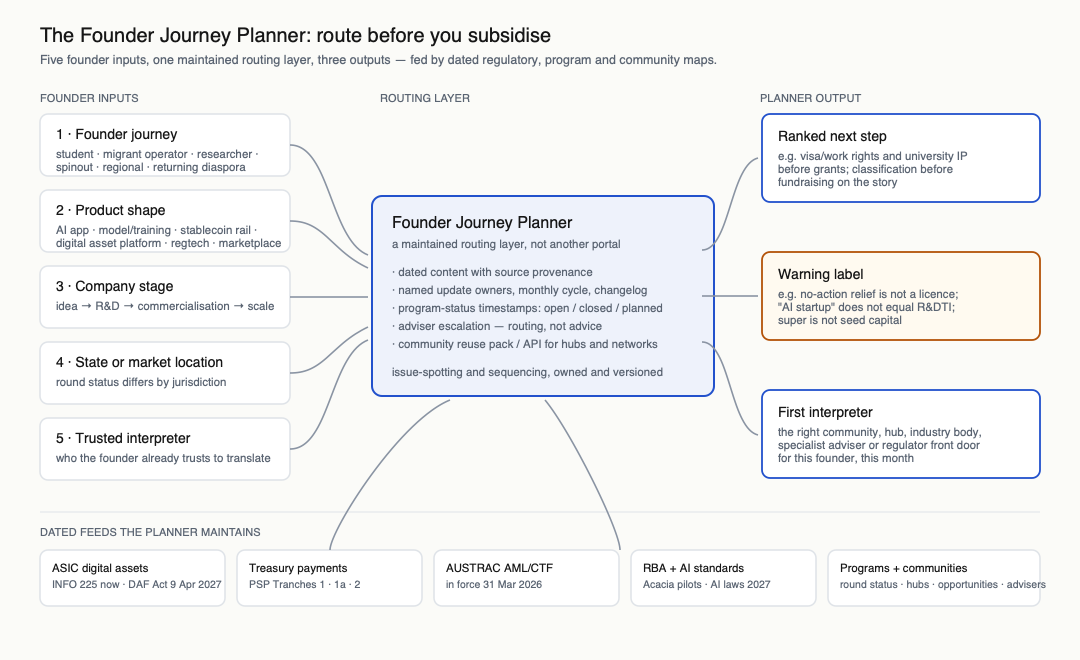
In practice, that planner should behave less like a brochure and more like an operating model. It should ask the founder for five inputs: founder journey, product shape, company stage, state or market location, and trusted interpreter. It should then return a ranked next step, a warning label, and the first human or community door to check. A student AI founder might see university IP and post-study work settings before R&DTI. A payments founder might see ASIC/Treasury/AUSTRAC classification before grants. A regional founder might see community and customer routes before capital. That sequencing is the point.
To avoid becoming another static portal, the Planner would need dated content, source provenance, named update owners, program-status timestamps, disclaimers, escalation paths to qualified legal/tax/migration/financial advisers, and community feedback loops. Its job would be issue-spotting and routing, not regulated advice.
The minimum viable version should be small enough to maintain: one accountable national owner, state and program data owners, a monthly update cycle, public changelog, source provenance on every pathway, and a reusable community pack or API that groups such as Superteam AU, Build Club and place-based hubs can use in office hours.
| Planner input | Ranked next step | Warning label | First interpreter |
|---|---|---|---|
| International student building an AI infrastructure tool | Check visa/work settings, university IP and co-founder/company setup before optimising for grants. | "AI startup" does not automatically mean R&DTI eligibility; document technical uncertainty only where it exists. | University founder program, Build Club, Arrayah-style builder space, Startmate/Antler Australia-style pathway or specialist AI peers. |
| Migrant operator building payments or stablecoin infrastructure | Classify the product across ASIC, Treasury, AUSTRAC and payments tracks before raising on the story. | AUSTRAC registration, ASIC relief, payments reform and RBA pilots are not interchangeable permissions. | Specialist legal/accounting adviser, Superteam AU, fintech/digital-asset operator peers and regulator materials. |
| Research founder commercialising deep tech | Secure IP rights, evidence technical uncertainty and test IGP advisory-first fit before chasing broad startup funding. | IGP is not a universal startup grant, and superannuation is not seed capital at the founder's front door. | University commercialisation office, R&DTI/IGP adviser, deep-tech investor, sector hub or pilot customer. |
| Regional founder with an early digital product | Find peer density, customer proof and the current state support route before assuming capital is the first blocker. | State programs are dated and round-based; check whether support funds founders, programs, events or ecosystem providers. | Place-based hub, state startup front door, remote accelerator, sector community or national builder network. |
The Founder Journey Planner Map
| Founder journey | First information need | Likely first doors | Risk if Australia hides the route |
|---|---|---|---|
| Immigrant skilled worker to founder | Work rights, PR timing, company setup, tax, employment/IP constraints and trusted local advisers. | Migration-aware founder guide, accountant/lawyer, startup community, state startup front door, accelerator. | The founder waits too long, starts informally, or moves to a jurisdiction with clearer setup and founder-visa pathways. |
| International student to founder | Student/graduate visa limits, university IP, co-founder formation, first customers and post-study work options. | University founder programs, student builder clubs, Build Club, Arrayah-style peer spaces, Startmate/Antler Australia-style pathways. | Australia trains the talent, then loses the founder before they build here. |
| Australian university or research founder | Commercialisation route, IP ownership, R&DTI, IGP, lab access, customer discovery and patient capital. | University tech-transfer office, IGP Advisory Service, R&DTI adviser, deep-tech investors, hubs and specialist communities. | Research stays trapped in papers, grants or pilots instead of becoming companies. |
| Corporate or operator spinout | Restraints, IP boundaries, first customer access, procurement, credibility and investor translation. | Sector bodies, legal/accounting advisers, Stone & Chalk-style hubs, investor-run communities, customer pilots. | Experienced operators keep building inside employers or leave Australia to find denser startup pathways. |
| Regional founder | Local support, remote capital access, peer density, state pathways, export/customer reach. | Place-based hubs, state startup front doors, national communities, remote accelerators, export support. | The ecosystem feels Sydney/Melbourne-only and ambition leaks offshore or into safer jobs. |
| Returning diaspora founder | Relocation setup, local investor/customer networks, competitor comparison, export/US expansion support. | Diaspora/operator communities, local VCs, state/federal export programs, Superteam/sector communities. | Australia feels administratively harder than the places the founder has already seen. |
| Underrepresented or community-trust founder | Trusted navigators, non-insider grant/capital access, culturally safe advice, peer examples. | Community-led programs, local hubs, founder networks, government front doors designed for non-insiders. | Support technically exists, but only insiders can use it. |
This broader table is the central claim. The policy question is not simply "what programs exist?" It is "which founder is trying to use them, what do they need to know first, and who do they trust to interpret the map?"
These pathways are not a statistical prediction of who becomes a high-growth founder; they are a coverage model for large founder-supply pools and the distinct first constraints that determine whether high-potential founders can start cleanly in Australia. The pools are real: the ABS counts 8.8 million overseas-born residents — 32% of the population — at June 2025, and the Department of Education reported more than 680,000 international students in Australia in the year to May 2026.
What Founders Can Use Now
Australia's support base is more substantial than the common critique suggests. The country already has grants, tax incentives, startup communities, investors, state programs, digital-asset reform, payments reform, AI policy work and credible public institutions. The challenge is that each support path has a shape.
R&DTI: Claim Experiments, Not Projects
The R&D Tax Incentive is the most important horizontal mechanism for R&D-heavy software, AI, cyber, infrastructure and deep-tech founders. The current ATO rate wording should be kept precise: for companies with aggregated turnover below $20 million, the refundable offset equals the corporate tax rate plus an 18.5 percentage point premium. For a 25% base-rate entity this is commonly 43.5%, but "corporate tax rate plus premium" is the safer public explanation. For companies at or above $20 million turnover, the non-refundable offset depends on R&D intensity: corporate tax rate plus 8.5 percentage points up to 2% R&D intensity, and plus 16.5 percentage points above that.
For founders, the practical rule is simple: claim experiments, not projects. A software company is not eligible because it is building something commercially novel. It needs activity-level evidence of technical uncertainty, hypothesis-led experimentation, observations, evaluation and conclusions. Known API integrations, normal configuration, UI assembly from established components, ordinary dashboard builds and routine data migration are weak fits. AI founders should treat R&DTI as a documentation discipline from day one: record the hurdle, the known approaches rejected, the experiment design, the test data, the failure modes and the conclusion.
The 2026-27 Budget reform matters, but it is future-state and, at the time of writing, announced rather than legislated. Current rules continue until the announced 1 July 2028 changes. The recommendation is not "rush claims before reform." It is that Australia should help technical founders understand eligible experimentation early enough that legitimate R&D activity is designed and recorded properly.
IGP: Powerful, Paused, And Poorly Suited To Routine SaaS
The Industry Growth Program is different. It is not a universal startup grant. It is a priority-aligned commercialisation bridge for novel SMEs and startups in National Reconstruction Fund priority areas, but the official page now says it is paused to new applications. The founder-facing route, when open, is advisory-first: Advisory Service report before any matched grant application. Early-Stage Commercialisation grants sit in the $50,000 to $250,000 range; Commercialisation and Growth grants sit in the $100,000 to $5 million range. Both require fit, evidence and matched contribution capacity.
That makes IGP useful for the right founder and inefficient for the wrong one. An industrial AI, cyber, defence, medtech, agtech, energy, transport, advanced-manufacturing or enabling-capability startup may have a real path when intake is open. A routine SaaS tool or consumer app should not be reshaped into a deep-tech story just to chase grant money. The operating-system answer is to route founders honestly: if IGP is paused or does not fit, spend the next month on customers, community, angels, accelerator pathways or state support instead.
Federal Tools Beyond Grants
Three further federal mechanisms belong on the same map. The tax incentives for early stage investors (the ESIC settings) give angel investors a carry-forward tax offset and CGT concessions for qualifying early stage innovation companies, which makes ESIC status worth checking before a first raise.
CSIRO Kick-Start offers dollar-matched funding of $10,000 to $50,000 for eligible startups and SMEs to run R&D with CSIRO researchers, with applications open year-round. Export Market Development Grants remain the main federal export-promotion pathway, with Export Finance Australia as the loan/guarantee complement once contracts exist. Status still matters: as at July 2026, no EMDG round is open to applications.
The employee share scheme settings reformed in 2022 also matter more than their profile suggests. Employees are no longer taxed on equity merely for leaving a job, and unlisted startups can make ESS offers with reduced disclosure: the quiet mechanics that let Australian startups compete for talent with equity rather than salary alone.
State Programs Need Dates, Not Hype
State and territory programs add another layer. NSW's MVP Ventures program was revamped for 2025-26 and remains a useful pre-market commercialisation pathway. Founders should still treat it as round-based and check current intake dates before planning around it: Round 3 closed on 10 April 2026.
Victoria's LaunchVic leans more toward accelerator and community infrastructure than direct-to-startup grant cash: its grant rounds fund program providers and investor groups rather than individual startups. LaunchVic is also being merged with Breakthrough Victoria into a new entity, Innovation Victoria, announced in December 2025 and expected to go live in the second half of 2026. Existing commitments stand, but Victorian founders should verify which doors survive the transition, including the Alice Anderson Fund, the $10 million sidecar fund that co-invests alongside private leads into women-led startups.
Queensland has Advance Queensland, with Ignite Ideas and Ignite Spark pathways requiring current status checks. Both rounds were closed at the time of writing, with Ignite+ providing follow-on support. WA's New Industries and Innovation Fund pathways — now administered by the Department of Energy and Economic Diversification, with Innovation Booster and Commercialisation Bridge grants of up to $50,000 and $250,000 respectively — are useful but round-based.
South Australia has clearer early-stage commercialisation support through Seed-Start and the Research and Innovation Fund, now administered by the Department of State Development, with Seed grants of $50,000 to $100,000 and Start grants of $100,001 to $500,000 open at the time of writing. ACT founders can route through CBRIN/ICON and related ACT Government support. NT is in transition, with Ignite and Darwin Innovation Hub more relevant than relying on the older Business Innovation Program. Tasmania should be framed carefully as support-led rather than direct-grant-led: Enterprize, Startup Tasmania, Business Tasmania and the City of Hobart provide practical first stops, while a currently open direct founder commercialisation grant equivalent to SA Seed-Start or NSW MVP Ventures was not verified in the latest source pass.
Program status is current to mid-July 2026 and should be rechecked before founders apply or before this paper is republished. The lesson is not that one state is good and another is bad. The lesson is that state support must be dated, direct about round status, and explicit about whether a program funds founders, accelerators, ecosystem providers or events.
Capital: Australia Has A Pool, Not A Pipe
Once the founder knows which doors are real, the next question is what kind of capital those doors can actually lead to.
The capital question starts with a real paradox. Australia has a huge long-duration savings base and a serious private-capital ecosystem, yet many founders still experience the market as thin, conservative, network-dependent and concentrated.
The Pool Is Real
APRA's March 2026 quarterly release (published 28 May 2026) put total superannuation assets at $4,437.9 billion — $4.4379 trillion — at 31 March 2026. RBA context frames superannuation as a major share of the financial system, with compulsory contribution flows and preservation settings that create unusual national savings depth. This is a real Australian strength.
The Missing Bridge
But the number can be misleading without structure. Superannuation is not a direct seed pool. Trustees manage member duties, liquidity, risk, retirement-income needs, performance tests, fees, portfolio construction, offshore allocation and stress-event resilience. A seed-stage founder is usually too small, too risky and too operationally raw for direct super fund investment.
The more useful claim is that Australia needs better bridges from the pool to founders. Those bridges include venture funds that can take institutional mandates, ESVCLP and fund-formation settings, growth funds, co-investment vehicles, fund-of-funds models, institutional-grade startup performance data, better secondary liquidity, procurement proof, corporate customer traction and regulatory clarity in sectors that trustees and investment committees need to diligence. The evidence layer is improving: Cut Through Venture and Folklore Ventures' State of Australian Startup Funding recorded $5.4 billion raised across 390 deals in 2025 — up 31% year-on-year and the third-largest funding year on record — exactly the kind of dataset trustees, investment committees and policymakers need before startup exposure can become a mandate.
Public capital vehicles also belong on this map. The National Reconstruction Fund Corporation provides debt, equity and guarantees across seven priority areas of the economy. Victoria's Breakthrough Victoria — transitioning to Innovation Victoria at the time of writing — invests patient capital from research translation through venture to growth, with digital technologies as a focus sector. The CEFC's Clean Energy Innovation Fund, managed by Virescent Ventures, is the Commonwealth's dedicated climate-tech venture investor from pre-seed to growth, with ARENA providing the grant-side complement for renewable energy technology. None of these is a seed cheque at the founder's front door, but each changes what a capital-staging plan can look like for the right company.
For the Founder Journey Planner, this matters because different founders need different capital translation. A research founder may need proof that grant-funded science can become a venture-scale company. A corporate operator may need customer contracts and clean IP separation before capital believes the spinout. A regional founder may need network access more than another government page. A returning diaspora founder may compare Australian capital density with Singapore or the Bay Area and decide whether to build here first, expand later, or move too early.
The most realistic near-term bridges are not direct super-to-seed cheques. They are institutional VC and growth mandates through managers that can meet trustee diligence; co-investment or fund-of-funds structures that aggregate startup exposure to a mandate size; ESVCLP-style fund formation that keeps early-stage capital professionally managed; and procurement or paid-pilot evidence that helps later investors underwrite technical and market risk. For founders, the bridge is therefore evidence design: customer proof, governance, clean IP, regulatory classification and milestones that survive diligence.
Australia should not promise founders that patient capital is waiting at the front door. It should show them what evidence moves them from invisible to investable.
Regulatory Clarity Is Competitiveness
Capital is only useful if the product can survive diligence. For digital economy founders, regulation is not a footnote. It shapes product design, capital confidence, customer trust and whether Australia feels like a serious place to build.
The first rule is to keep reform tracks separate. The summary box below is the sorting logic; the detail follows.
Keep The Tracks Separate
| Track | What it is | What it is not |
|---|---|---|
| ASIC digital assets (INFO 225 → DAF Act) | Current-law classification guidance now; DAP/TCP licensing from 9 April 2027. | Not a waiting room: current obligations apply today, and no-action relief is not a licence. |
| Treasury payments (PSP Tranches 1, 1a, 2) | Licensing, safeguarding and stablecoin/stored-value reform for payment functions. | Not the same as digital-asset licensing, and not yet law — draft legislation stage. |
| AUSTRAC AML/CTF (virtual assets) | Designated-service registration and obligations, in force since 31 March 2026. | Not an ASIC licence and not permission for any financial product feature. |
| RBA tokenisation (Project Acacia) | Official wholesale settlement experimentation and evidence. | Not broad retail permission for tokenised products. |
| AI policy (National AI Plan -> Australian Standards for AI) | A pivot from light-touch settings toward legislated standards, aimed first at data centres and training infrastructure. | Not yet an application-layer AI licensing regime — a watch item until legislation lands. |
Digital asset founders need to understand current ASIC guidance and future digital asset platform reform at the same time. ASIC INFO 225 remains the current-law classification guide: rights, benefits, product features, marketing and surrounding arrangements matter more than token labels. The Digital Assets Framework Act — formally the Corporations Amendment (Digital Assets Framework) Act 2026, announced through Treasury — passed Parliament on 1 April 2026, received Royal Assent on 8 April 2026, and commences on 9 April 2027.
ASIC's roadmap points to guidance, licensing applications, relief during processing and then supervision/enforcement. ASIC also extended the digital-asset no-action position to 30 September 2026 on 25 June 2026, but that is conditional transition relief. It is not a licence and not permission to ignore current law.
For products that fit its conditions, ASIC's Enhanced Regulatory Sandbox offers a separate door: up to 24 months of licence-free testing under notification and eligibility rules. ASIC's Innovation Hub remains the free, informal-assistance front counter for licensing questions before committing to either path.
Payments, CDR And Digital ID
Payments are a separate track. Treasury's PSP Tranche 1 draft legislation consultation closed on 14 April 2026 and covers payment functions, licensing, safeguarding payment-related money, exemptions, unclaimed money, APRA powers and ePayments Code rule-making. The stablecoin and stored-value-facility elements were consulted separately as Tranche 1a, which closed in November 2025 — stablecoin founders should track both. Tranche 2 is expected to consider access, standard setting and ePayments Code updates. Founders building account-to-account workflows, stored value, merchant settlement, payroll, B2B payments or stablecoin-adjacent payment rails should keep an assumptions register rather than waiting for one perfect answer.
Three adjacent rails belong in that same assumptions register. The Consumer Data Right remains live in banking and energy and began extending to non-bank lenders on 13 July 2026, though action initiation — CDR-initiated payments — is legislated but paused, with no action types yet declared. Account-to-account modernisation continues on NPP and PayTo, but AusPayNet formally dropped the June 2030 BECS decommissioning date in December 2025, with the RBA overseeing a new roadmap through 2026 — build NPP-native, but do not plan around a fixed cut-over date. And the Australian Government Digital ID System opens to accredited private providers and relying services such as banks and telcos by December 2026, which reshapes KYC and onboarding economics for anyone verifying identity.
AUSTRAC AML/CTF reform is a third track. Home Affairs says virtual asset sector changes commenced 31 March 2026. AUSTRAC materials distinguish fiat/virtual asset exchange, virtual asset-to-virtual asset exchange, virtual asset transfer, safekeeping/control and issuer-sale related services, with some obligations for newly registrable virtual asset services deferred until 1 July 2026 and a hard deadline for pre-1 July providers to apply to enrol and register by 29 July 2026. Existing digital currency exchange registrants automatically became VASPs on 31 March 2026. A founder cannot treat AUSTRAC registration, ASIC licensing, payments reform and RBA tokenisation work as interchangeable badges.
RBA tokenisation work is a fourth track. Project Acacia shows official interest in wholesale tokenised market infrastructure and settlement experimentation. It does not mean retail tokenisation products have broad permission. The founder lesson is to narrow the use case, map legal rights and settlement assets, use credible counterparties, and treat pilots as evidence rather than marketing decoration.
AI: Transitional Rules, Not A Blank Cheque
AI policy is now a fifth track. The National AI Plan, released in December 2025, set a light-touch, pro-adoption direction: no dedicated AI Act, reliance on existing technology-neutral law, an AI Safety Institute, and SME adoption support through the AI Adopt Centres. Then, on 15 July 2026, the Prime Minister announced an Office of AI inside PM&C, Australian Standards for AI, data-centre expectations around energy, water, location and verification, creator-control and copyright commitments, National Cabinet consideration in August 2026 and legislation expected in early 2027.
That is best read as a pivot toward legislated standards, which means founders should treat current settings as transitional. It does not mean every AI startup is suddenly regulated as a data centre, and application-layer obligations should remain a watch item until draft legislation or standards are released. It does mean AI founders need to classify the product shape: application layer, model provider, training workflow, creator tool, procurement-facing product, compute infrastructure or large data-centre dependency.
For practical adoption guidance in the meantime, the National AI Centre's Guidance for AI Adoption — which replaced the Voluntary AI Safety Standard in October 2025 — and its AI.gov.au platform are the current official starting points.
The Founder Test
This is where Australia can compete. Serious rules do not automatically deter founders; hidden rules do. If Australia can give founders product-shape checklists for DAF/ASIC, PSP/Treasury, AUSTRAC AML/CTF, RBA tokenisation and AI standards, it can turn high trust into a build-from-Australia advantage.
What Working Operators Show
The regulatory map is abstract until it is tested against companies operating today. These are not hero-marketing case studies; they are patterns — regulated pilots, compliance-first infrastructure, current registration pathways, transition risk and litigation risk — and they answer the practical question of where founders are successfully operating under current frameworks.
Canvas and Banking Circle in Project Acacia. Australia's first live repo transaction under Project Acacia saw Canvas tokenise an Australian Government Bond pledged as collateral while the RBA issued pilot wholesale CBDC, with Banking Circle providing the fiat leg as a pilot wCBDC distributor — an event the companies billed as the first CBDC issuance on a public blockchain. ASIC granted targeted regulatory relief for the pilots. The lesson is not that anyone can now issue tokenised securities. It is that serious wholesale pilots need narrow use cases, credible counterparties, settlement design and regulator engagement.
Zerocap and Independent Reserve. Zerocap states it is registered with AUSTRAC as a digital currency exchange provider and that its spot crypto-asset services are not regulated by ASIC (some of its wholesale derivative products are); Independent Reserve likewise discloses its AUSTRAC DCE registration. Both show digital asset businesses operating today under current settings — and the limits of a single registration. AUSTRAC registration is not ASIC permission for every product feature, and DAF transition planning still matters. Zerocap was also a named Project Acacia lead participant, which is what regulated-pilot credibility looks like in practice.
AUDD and AUDC. AUDD, the Australian-dollar stablecoin, is issued by AUDC Pty Ltd under AFSL 700123, authorising it to issue and deal in non-cash payment products — an authorisation announced via a February 2026 ASX release from Novatti, then an AUDC minority holder, which framed the AFSL as removing a regulatory barrier for banks and asset managers to hold AUD-backed digital assets. This is the compliance-first stablecoin route: "stablecoin" is not a legal category, and the classification question is answered through backing, redemption rights, non-cash payment facilities and AML/CTF readiness.
Block Earner. The cautionary case, now with a definitive ending: on 17 June 2026 the High Court found unanimously for ASIC — the now-closed Earner fixed-yield product was a financial product requiring a licence, because the Corporations Act looks to contractual substance, not marketing labels. Whatever a founder thinks of the policy outcome, the operating lesson is sharp: labels such as DeFi, fixed yield or access product do not control the classification answer, and litigation is not a go-to-market plan.
IGP's digital-economy recipients. The Industry Growth Program recipients list includes AI health, cyber, defence decision-support and industrial AI companies. That is not proof that every SaaS startup can get IGP money; it is proof that federal commercialisation support reaches digital-economy companies when the project is priority-aligned, technical and evidenced.
Communities Translate The Route
Even the cleanest official map still needs interpreters. This is where communities move from informal support into practical infrastructure.
The original founder-support map is incomplete unless it treats communities as infrastructure. A founder rarely moves because a government website exists. They move because a person, peer group, operator, adviser or investor helps interpret the next step.
What Communities Actually Do
The table below is an analytical reading of community roles, not a claim that every listed network produces the same measurable outcomes. Public institutions, private networks, selective accelerators, investor-run communities and informal builder spaces have different incentives and access rules. The examples vary in maturity and function: programs, hubs, investor pipelines and builder communities. The point is to separate official facts from the trusted interpretation layer founders actually use.
| Community layer | Australian examples | Routing role | Caveat |
|---|---|---|---|
| Builder and technical communities | Build Club, Arrayah, Peregian Digital Hub AI Lab and Tokenizer | Help founders learn by building, find peers, test prototypes, join show-and-tell loops, and turn curiosity into momentum. | Do not treat every builder community as a grant or accelerator. The value is peer density, practice and trust. |
| Web3 and digital-asset communities | Superteam Australia, Solana ecosystem grants and funding, protocol communities | Route builders toward grants, jobs, collaborators, crypto-native operator knowledge and stablecoin/payment experiments. | Best for real Web3, payments, digital-asset and protocol-adjacent founders; not every digital economy startup should force-fit into crypto. |
| Accelerator and founder networks | Startmate, Antler Australia | Provide structure, mentor access, validation pressure, co-founder formation, investor readiness and social proof. | Selection mechanisms matter. These are not neutral public entitlements. |
| Place-based hubs | Stone & Chalk, Spacecubed in Perth and Western Sydney, Western Sydney Startup Hub, Cremorne Digital Hub, Brisbane-based Queensland AI Hub, Gold Coast Innovation Hub, CBRIN, Darwin Innovation Hub, Enterprize, Peregian Digital Hub, Tank Stream Labs | Create local density, event flow, industry connections, government adjacency, regional access and founder visibility. | A desk is not the product. The real value is network access, repeated interaction and local translation. |
| Industry and policy bodies | DECA (Digital Economy Council of Australia, formerly Blockchain Australia), FinTech Australia, Tech Council of Australia | Aggregate founder problems into policy submissions, translate reform consultations into member briefings, and connect founders to regulators, advisers and peers. | Advocacy bodies, not regulators or licensing authorities; access and priorities follow membership. |
| Investor-run communities | Blackbird Ventures / Blackbird Giants, Folklore Ventures networks and fund communities | Translate founder ambition into fundability, operator feedback, investor expectations and long-term capital relationships. | Useful, but also part of capital pipelines and selection systems. |
Arrayah should be handled precisely. Its relevance is not that it is a government program, a university pathway, a grant or a conventional accelerator. It is emerging hackerhome, residency and community infrastructure: workspace, peer groups, showcase days, co-living and high-agency founder/researcher/artistic density in places such as Sydney and Perth. That matters because founder journey planning is partly social. Some founders do not need another PDF. They need to be around other people who are building quickly, learning in public and introducing them to the next credible door.
Place-Based Hubs Matter
The place-based layer is important because Australia's digital-economy map is not only Sydney and Melbourne. Queensland has several different doors: Peregian Digital Hub and its AI-focused programs on the Sunshine Coast, the Brisbane-based Queensland AI Hub, and the Gold Coast Innovation Hub for startup and digital-business support. Victoria's Cremorne Digital Hub connects scale-up founders, industry, universities and investors in Melbourne's Cremorne tech precinct.
Spacecubed matters beyond a generic WA coworking mention because it operates Perth hubs and the Western Sydney Startup Hub in North Parramatta, and its AI Fellowship explicitly links Perth and Western Sydney AI founders as one cohort. University programs round out the map: UNSW Founders and the Melbourne Accelerator Program are among the most established campus-to-company pathways, and Tank Stream Labs operates workspace communities across Sydney, Melbourne, Adelaide and Brisbane.
For the underrepresented-founder row of the Planner map, named doors matter more than categories: First Australians Capital — Indigenous-led, with more than $90 million channelled into over 1,000 First Nations businesses since 2016 — and Victoria's Alice Anderson Fund for women-led startups are the kind of trusted, specific entry points that row needs. Those examples strengthen the Planner thesis: founders need a current local interpreter as much as a national program list.
The hub layer is also fragile, which is itself an argument for dated maps. Fishburners entered voluntary administration in May 2026, and the NSW Government withdrew funding from the Techstars Tech Central Sydney accelerator; the CBD Sydney Startup Hub's services moved to Tech Central after the Wynyard site closed. A Planner that lists hubs without update discipline would mislead the founders who trust it most.
Superteam AU's Specific Role
Superteam AU's value is specific: it can help Solana, stablecoin, payments and digital-asset builders find protocol collaborators, grant paths, compliance-minded peers and demo loops. It should also tell founders when crypto is the wrong wrapper for the product. That honesty is what makes the community useful as infrastructure, not just as event flow.
The SOLAUDD developer program coverage — a Solana grant program launched in April 2026 in partnership with AUDC, the issuer of the AUDD Australian-dollar stablecoin — is useful because it shows Superteam AU at the intersection of Solana builders and Australian-dollar stablecoin/payment infrastructure. The Solana Foundation Australia Grants on Superteam Earn are a durable entry point into that funding layer.
For Solana builders in Australia, the opportunity is narrower and sharper than "more Web3 activity." Australia can be a credible base for payment, stablecoin, compliance, tokenisation, developer-tooling and internet-capital-markets experiments that can survive contact with real customers and real regulation.
Communities Need Official Maps To Translate
Industry bodies are the formal half of this interpretation layer. DECA — the Digital Economy Council of Australia, rebranded from Blockchain Australia in 2024 — made formal submissions into the digital asset framework consultations that produced the 2026 Act, and FinTech Australia's policy submissions span the PSP licensing tranches, the digital assets framework and payments reform. The Tech Council of Australia plays the whole-of-sector role. For a payments or digital-asset founder, these bodies are where individual regulatory confusion becomes collective policy signal, and where the reform tracks described above get translated into member briefings before official guidance catches up.
The public policy answer is not to nationalise community. It is to recognise community as a routing layer and make the official system easier for communities to interpret. Government can publish dated maps, clean product-shape checklists and program APIs. Communities can translate them into founder decisions.
Competitor Pressure: Founders Compare Routes
Australia is competing on founder experience, not only tax rates or headline grant amounts. The scoreboard is real: Startup Genome's 2025 global ranking values Sydney's startup ecosystem at US$55 billion (25th globally) and Melbourne's at US$18 billion, with more than 230 Australian startups valued above $100 million.
Dubai and the UAE offer a more legible first door for some founders by packaging the route visibly: VARA for virtual assets (with its activity-based rulebooks), ADGM in Abu Dhabi and DIFC infrastructure (the DIFC sits outside VARA's remit, under its own regulator), DMCC sector ecosystems, free-zone setup and a tax story that is simple to describe even when the actual treatment has conditions. The downside is that founders still need to check the exact licensed activity, free-zone versus onshore status, banking access, substance requirements, customer trust and rulebook cost. But the first impression is clear: "there is a door."
Singapore offers a more legible first door through credibility. MAS sandboxes, payment-services licensing, a stablecoin framework finalised in August 2023, Startup SG, EntrePass, Tech@SG, regional headquarters logic and banking trust make it easy for founders and investors to understand why a company might base itself there. The downside is cost, compliance burden, a small domestic market and eligibility rules. Still, the route is legible.
Three other jurisdictions sharpen the same lesson without deserving full journeys here. The UK keeps its FCA regulatory sandbox open year-round and finalised its cryptoasset regime rulebook on 30 June 2026 — though the regime does not commence until 25 October 2027, a slower clock than Australia's April 2027 start. Hong Kong's Stablecoins Ordinance has been in force since 1 August 2025, with the first issuer licences granted in April 2026 — the clearest live example of the licensing clarity Australian stablecoin founders are waiting for. And the EU's MiCA has been fully applicable since 30 December 2024, giving authorised crypto-asset service providers passporting across the bloc. Each shows a different version of the same competitive move: publish the rulebook, date the clock, and let founders plan against it.
Vietnam offers a more legible cost-and-talent route for some teams. Its National Innovation Center, AI and semiconductor programs, digital-economy ambitions and young technical base make it relevant for engineering, AI and Southeast Asian market access. The downside is less mature regulatory certainty for fintech and digital assets, plus foreign-company, data, employment and banking complexity. It is not the same kind of competitor as Singapore, but it affects where founders build teams.
Silicon Valley and the US remain the strongest relocation narrative in the founder imagination. Part of that narrative is true. For AI infrastructure, developer tools, enterprise software, cybersecurity and companies that need US customers, lead investors, acquirer attention or YC-style network effects, the Bay Area can accelerate learning and capital access. But relocation does not create founder-market fit. It adds immigration, cost, healthcare, legal, payroll and distraction risk. Australia should help founders make the move when it solves a concrete bottleneck, not because "unicorns move to San Francisco" became folk wisdom.
| Ecosystem | Visible first door | What it helps with | What it does not solve | Australian lesson |
|---|---|---|---|---|
| Australia | R&DTI, IGP, state programs, regulator pages, startup communities and sector customers. | Trust, research depth, regulated pilots, Australian-dollar infrastructure, sector customers and local community interpretation. | Fragmentation, round timing, founder-stage capital translation, procurement speed and global-market access. | Keep the strengths, but make the route explicit by founder pathway and product shape. |
| Singapore | MAS sandbox/licensing, Startup SG, EntrePass, Tech@SG and regional HQ logic. | Credibility, financial-regulation clarity, banking trust, Southeast Asian access and investor legibility. | Cost, small domestic market, eligibility limits and compliance burden. | Package regulatory and market-entry routes in a way founders and investors can understand quickly. |
| Dubai/UAE | VARA, ADGM, DIFC, DMCC, free-zone setup and regional market positioning. | Clear first impression, virtual-asset visibility, regional expansion and tax/setup narrative. | Exact licence scope, banking, substance, onshore/free-zone boundaries and rulebook cost. | A visible door matters, but Australia should compete on trust and substance rather than copy the free-zone model. |
| Vietnam | National Innovation Center, digital-economy strategy, young technical base and market growth. | Engineering talent, cost, growth-market access and regional team building. | Less mature fintech/digital-asset certainty, foreign-company setup, data and banking complexity. | Talent and cost pressure are real, so Australia needs better routes for technical founders to build teams here and expand regionally. |
| Silicon Valley/US | YC, venture density, Delaware/C-corp defaults, enterprise customers and talent networks. | Lead capital, US customers, exit signalling, AI/developer-tool density and network effects. | Immigration, cost, healthcare, payroll, legal complexity and relocation distraction. | Help founders move when the bottleneck is real, while keeping Australian R&D and regulated proof points anchored where useful. |
The competitive answer is staged. Build in Australia when the next proof point is technical R&D, a regulated Australian pilot, an Australian-dollar payment or stablecoin use case, government or enterprise procurement, or a sector where Australia has natural customers such as resources, energy, agriculture, defence, health or financial infrastructure. Expand offshore when the bottleneck is genuinely customers, capital, talent density, licensing, market access or exit signalling. When that moment comes, Austrade's Landing Pads — now delivered as cohort-based immersions, delegations and bootcamps across Indonesia, Singapore, Vietnam, the UK and the US rather than permanent overseas hubs — is the official staged-expansion door for scaleups with traction and runway.
What This Would Not Solve
A Founder Journey Planner would not make Australia a larger domestic market, remove the need for offshore customers, or turn superannuation into early-stage venture capital. It would not remove compliance costs for payments, digital assets, AML/CTF, AI, migration, tax or securities law. It could also become another stale portal if no one owns updates, source provenance and program-status checks.
The strongest counterargument is that routing is not the binding constraint for every founder. For some companies, the real constraint is customer access, lead capital, procurement risk, local market size, a visa setting, or the need to be in the US or Singapore early. That is why the Planner should not promise one national answer. It should expose the first constraint, show the route, and help the founder decide when Australia is the right base and when offshore expansion solves a real bottleneck.
What Australia Should Do Next
Australia's next move should be practical and founder-facing. A routed layer on top of what already exists would improve the experience before any grand new institution is created.
| Recommendation | Owner | First 90 days | 12-month measure | Founder benefit |
|---|---|---|---|---|
| Build a Founder Journey Planner navigation layer | Federal government with states, startup communities and industry bodies | Publish pathway pages for migrant founders, student founders, research founders, operator spinouts, regional founders and returning diaspora founders. | Live usage metrics, referral completions and founder satisfaction by pathway. | Founders start from their real constraint instead of a generic grants list. |
| Publish dated product-shape regulatory checklists | Treasury, ASIC, AUSTRAC, RBA, Office of AI and industry bodies | Release plain-English checklists for digital asset platforms, tokenised custody, stablecoins, PSPs, VASPs, AI apps, AI model/training workflows and AI infrastructure. | Reduced basic enquiry load, more complete licence/sandbox conversations, fewer category mistakes. | Founders know which regime to assess before they build too far. |
| Turn communities into official interpreters, not official substitutes | Superteam AU, Build Club, Arrayah, Startmate, hubs, VC communities and government program owners | Create a monthly dated routing brief that communities can reuse in events, office hours and founder onboarding. | Active community-maintained route maps and measurable referrals into programs, advisers and pilots. | Trusted peers can guide founders without inventing facts from scratch. |
| Build capital bridges from super/private capital to startups | Treasury, super funds, private-capital managers, VC funds and ESVCLP stakeholders | Identify mandate-sized vehicles, co-investment models and reporting standards that make startup exposure investable. | More institutional commitments to venture/growth vehicles and better startup performance data. | Founders see a path from early evidence to growth capital without pretending super is seed money. |
| Use procurement and pilots as ecosystem finance | Commonwealth, states, corporates and regulated infrastructure operators | Create challenge statements and pilot pathways for AI, cyber, payments, tokenisation, regtech, energy, resources and health. | More paid pilots, reference customers and procurement conversions. | Founders get customer proof, not just advice. |
| Make offshore expansion staged and explicit | Austrade, state trade agencies, accelerators, VCs and founder communities | Publish decision guides for US, Singapore, Dubai/UAE and Vietnam expansion by product type and stage. | More founders keeping Australian R&D and early pilots while opening offshore presence only when useful. | Australia retains value while helping ambitious companies go global. |
Route before you subsidise. A founder who is routed well can choose the right grant, community, adviser, regulator, investor or offshore market. A founder who is routed badly wastes months applying for the wrong program, misreading reform, under-documenting R&D, chasing capital too early, or leaving Australia because another country made the route feel easier.
What Better Routing Should Deliver
A founder should not need to become a grants officer, migration navigator, regulatory analyst, tax adviser, community scout and international benchmarking expert before proving the product.
Australia has the talent, capital, institutions, communities and sector advantages to compete. The next job is to make the path usable: route before you subsidise.
Appendix: A Sample Monthly Routing Brief
This is what one month of the Planner looks like in practice — a one-page brief a community like Superteam AU, Build Club or a place-based hub could reuse in events, office hours and founder onboarding. Everything below is drawn from the sources cited in this paper, with the core dated regulatory and migration claims refreshed on 22 July 2026.
Changed this month (July 2026). The Prime Minister announced the Office of AI and Australian Standards for AI on 15 July — treat current AI settings as transitional. Consumer Data Right product-data sharing extended to non-bank lenders on 13 July. Defence's ASCA announced its 2026 Pitch Day on resilient command-and-control, with shortlisted pitches at ADSTAR in Adelaide, 4–6 August.
Deadlines in the next 90 days. AUSTRAC: providers of newly registrable virtual asset services operating before 1 July must apply to enrol and register by 29 July 2026. National Cabinet considers the AI approach in August 2026. ASIC's digital-asset no-action position expires 30 September 2026 — the nearest regulatory cliff for unlicensed digital-asset businesses.
Round status. Open: SA Seed-Start (Seed $50k–$100k; Start $100,001–$500k), CSIRO Kick-Start (year-round), NT Ignite. Paused or closed between rounds: IGP, EMDG, NSW MVP Ventures (Round 3 closed 10 April), QLD Ignite Ideas and Spark, WA Innovation Booster and Commercialisation Bridge. In transition: LaunchVic and Breakthrough Victoria merging into Innovation Victoria in the second half of 2026 — verify which Victorian doors, including the Alice Anderson Fund, survive.
Warning of the month. The High Court's unanimous Block Earner ruling (17 June) confirmed that classification follows contractual substance, not product labels. If your product promises yield, redemption or access to money, classify before you launch.
How to reuse this brief. Swap in your community's sector lens, keep every line dated and sourced, publish a changelog, and route anything ambiguous to a qualified adviser. The brief is issue-spotting, not advice.
Selected Sources
Ecosystem frame
- Superteam Earn Australia region
- Superteam AU
- Superteam Australia / AUDD SOLAUDD developer program coverage
- Solana Foundation Australia Grants on Superteam Earn
Federal support, grants and incentives
- R&D Tax Incentive overview
- R&D Tax Incentive software development guide
- ATO R&D Tax Incentive rates
- Industry Growth Program
- Industry Growth Program grant recipients
- ATO tax incentives for early stage investors (ESIC)
- CSIRO Kick-Start
- Export Market Development Grants (Austrade)
- Austrade Landing Pads
- Advanced Strategic Capabilities Accelerator (Defence)
- ATO employee share scheme changes
Migration, IP and talent settings
- Student visa (subclass 500) — Home Affairs
- Temporary Graduate visa (subclass 485), Post-Higher Education Work stream — Home Affairs
- Visa Pricing Estimator — Home Affairs
- National Innovation Visa (subclass 858) — Home Affairs
- HERC IP Framework (Department of Education)
State and territory pathways
- NSW MVP Ventures Program
- NSW MVP Ventures 2025-2026 Round 3
- NSW MVP Ventures revamped program announcement
- LaunchVic
- Advance Queensland Ignite Ideas Fund
- Advance Queensland Ignite Spark Program
- Advance Queensland Ignite+
- WA New Industries and Innovation Fund grants
- SA Research and Innovation Fund (Department of State Development)
- SA Seed-Start grants
- Alice Anderson Fund (LaunchVic)
- ACT CBRIN
- Darwin Innovation Hub
- Business Tasmania grants and funding
- Startup Tasmania resources
- Enterprize
Capital and superannuation
- APRA March 2026 superannuation statistics
- APRA quarterly superannuation statistics
- RBA Financial Stability Review March 2026
- ASIC REP 823 capital markets discussion response
- Early Stage Venture Capital Limited Partnerships
- Blackbird Ventures ESVCLP customer story
- Folklore Ventures ESVCLP customer story
- National Reconstruction Fund Corporation
- Breakthrough Victoria
- CEFC Clean Energy Innovation Fund
- State of Australian Startup Funding 2025 (Cut Through Venture and Folklore Ventures)
- First Australians Capital
- Startup Genome 2025 ecosystem rankings (Forbes Australia coverage)
Operator case studies
- Banking Circle / Canvas Project Acacia announcement
- Zerocap
- Independent Reserve
- AUDD (issued by AUDC Pty Ltd, AFSL 700123)
- Novatti ASX announcement on AUDC AFSL (11 February 2026)
- Export Finance Australia
- ABS — Australia's population by country of birth
- Department of Education — international student monthly summary
Regulation, digital assets, payments, tokenisation and AI
- ASIC digital assets guidance INFO 225
- Corporations Amendment (Digital Assets Framework) Act 2026 — authoritative text
- Treasury digital asset laws media release
- ASIC Enhanced Regulatory Sandbox
- ASIC digital asset roadmap
- ASIC no-action extension to 30 September 2026
- Treasury payments licensing reforms
- Treasury PSP Tranche 1 draft legislation consultation
- Treasury PSP Tranche 1a (stablecoins) draft legislation consultation
- AUSTRAC virtual asset service providers
- AUSTRAC VASP registration guidance
- AUSTRAC virtual asset designated services
- AUSTRAC AML/CTF transitional rules 2026
- Home Affairs virtual asset sector AML/CTF changes
- RBA Project Acacia final report
- ASIC 25-129MR — Project Acacia participants and regulatory relief
- ASIC 26-124MR — High Court Block Earner decision (17 June 2026)
- Prime Minister AI in Australia's interests announcement
- AI.gov.au
- National AI Centre
- Guidance for AI Adoption (DISR, replaced the Voluntary AI Safety Standard in October 2025)
- National AI Plan (December 2025)
- AI Adopt Centres
- Consumer Data Right rollout
- ASIC Innovation Hub
- RBA BECS decommissioning oversight
- AusPayNet BECS outlook revision (December 2025)
- Australian Government Digital ID System
Communities and founder infrastructure
- Build Club
- Build Club Campus
- Arrayah
- VC Down Under fireside chat at Arrayah hacker house
- Startmate
- Peregian Digital Hub
- Peregian Digital Hub Tokenizer
- Queensland AI Hub
- Gold Coast Innovation Hub
- Stone & Chalk
- Spacecubed
- Spacecubed locations
- Spacecubed AI Fellowship
- Western Sydney Startup Hub
- Cremorne Digital Hub
- Antler Australia
- Blackbird Ventures
- Blackbird Giants
- Folklore Ventures
- Tank Stream Labs
- UNSW Founders
- Melbourne Accelerator Program
- DECA — Digital Economy Council of Australia
- DECA policy submissions
- DECA Proactive Policy Paper 2026
- FinTech Australia
- FinTech Australia policy submissions
- Tech Council of Australia
- Sydney Startup Hub transition to Tech Central
International comparison
- Dubai VARA
- VARA Rulebooks
- ADGM digital assets
- DIFC Innovation Hub
- DMCC Crypto Centre
- MAS FinTech Regulatory Sandbox
- MAS stablecoin regulatory framework
- Singapore MAS / EDB FinTech Regulatory Sandbox
- Singapore EntrePass
- Singapore Tech@SG
- UK FCA regulatory sandbox
- UK FCA cryptoasset regime
- HKMA stablecoin issuer regime
- EU MiCA (ESMA)
- Vietnam National Innovation Center
- Vietnam Innovation Challenge
- YC standard deal
- Silicon Valley Index 2026
Responsible AI Usage Disclosure
AI-assisted research and editorial tools helped identify, compare and correlate public sources, structure the source-backed route maps, and suggest editorial improvements. Cited sources were human-reviewed before inclusion. The thesis, interpretation, recommendations, source selection and final accountability remain human-led.